
The Future is Simulated: How Digital Twins are Transforming Medical Research
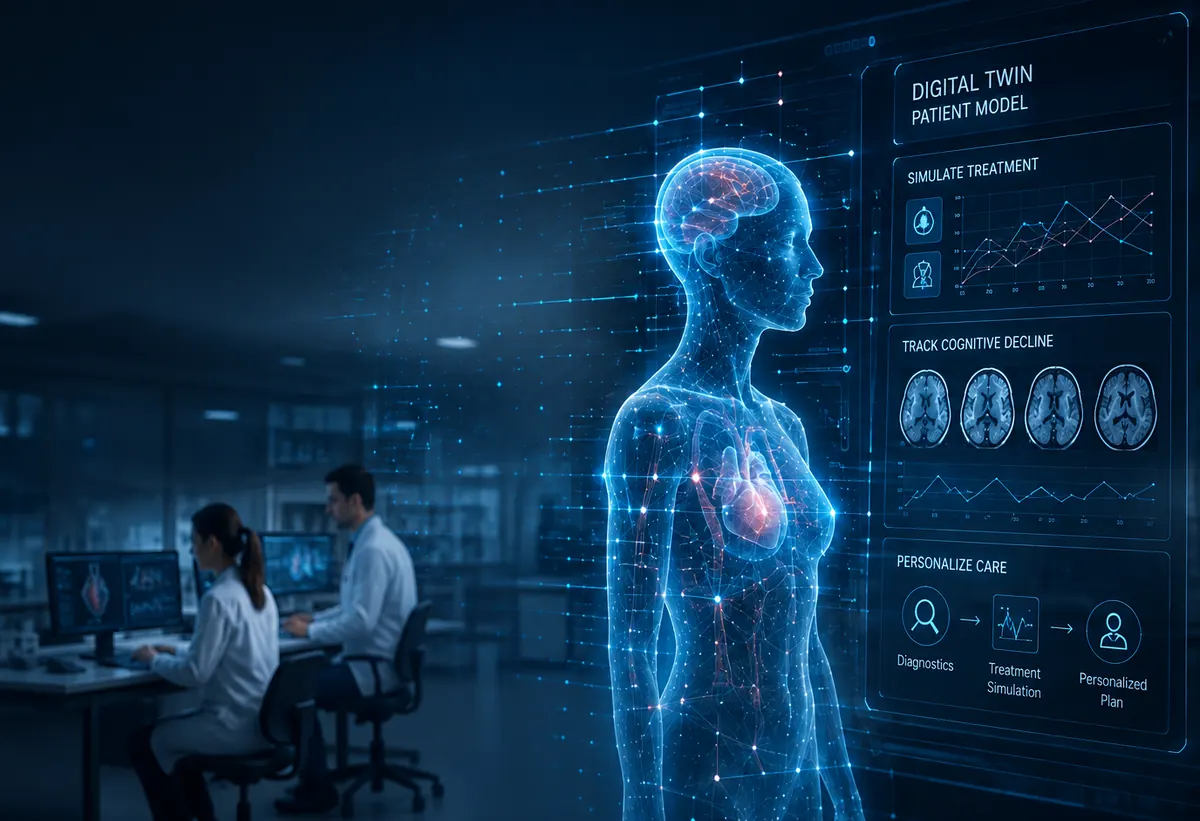
Digital twins as dynamic, virtual models of physical entities are migrating from engineering straight into clinical healthcare. Researchers are creating digital replicas of patients to simulate treatments, track cognitive decline, and personalize care. Here is a look at how digital twins are being deployed in medical research through three recent examples.
AI-Driven Architectures for Cognitive Aging
In a recent framework published in JMIR AI, researchers detailed a specialized digital twin architecture designed for managing cognitive aging and conditions like mild cognitive impairment. This framework is deployed to the cloud to continuously ingests multimodal streams of data, ranging from physiological signals like heart rate and EEG to behavioral indicators such as gait, speech, and sleep patterns.
By applying machine learning, a cloud-based platform analyzes these inputs to update the digital twin and predict cognitive risk trajectories. The overarching system then recommends adaptive interventions, such as personalized mind-body exercises or cognitive rehabilitation strategies, constantly adjusting the intensity based on how the framework’s models predict the real-world patient will respond.
Simulating Treatments and Synthetic Cohorts
A report from the Harvard Gazette highlights how researchers are using digital twins to revolutionize Alzheimer’s treatments and clinical trials. Instead of relying solely on broad group averages to determine if a therapy will work, scientists like Dr. Chao-Yi Wu can generate multiple “digital look-alikes” matching a specific patient’s age, genetics, and clinical history. This allows them to simulate and compare potential cognitive trajectories with or without the treatment.
Digital twins are also being used to build entirely “synthetic cohorts” capable of simulating randomized controlled trials before recruiting a single real patient. On a cellular level, researchers like Dr. Marinka Zitnik are integrating digital twins with large language models, allowing oncologists to interact with a synthetic version of a patient’s cells via chatbot to predict tumor responses to specific immunological drugs.
Generative AI for the Complete Patient Profile
In his May 2026 Grand Rounds presentation for the University of Washington’s Department of Neurology, Dr. Shawn Murphy explored the frontier of building patient digital twins using machine learning and generative AI within the i2b2 platform for EHR data.
This approach utilizes generative AI to synthesize complex, longitudinal patient information, like EHR, lab results, and imaging, into a cohesive, dynamic virtual model. Generative AI allows researchers to bridge missing gaps in clinical data and simulate individualized disease progression over time. By modeling these vast datasets, researchers can accurately forecast clinical trajectories and test the efficacy of precise interventions at scale, moving closer to truly individualized neurology.